A surgery appointment opens up. You've got an animal who's ready, a spot on the calendar, and someone lined up for transport. One more step toward getting them home.
Then surgery happens. And sometimes, there's still a lot of waiting.
For adult cats spayed or neutered during their stay, the median time from intake to surgery was seven days. From surgery to adoption? Thirteen days.
Those thirteen days aren't necessarily a problem. Recovery takes time. Some animals need additional care, while others are still waiting for an adopter.
But the numbers raise an interesting question: Once surgery is done, what's keeping an animal from going home?
Last month, we explored the rhythms of a shelter's week. This month, we're looking at the time between intake and adoption.
We examined cats and dogs adopted by Shelterluv organizations from October 2025 through September 2026, separating their stays into days before and after surgery.
Here's what we found.
The wait looks different at every age
For kittens arriving before eight weeks old, the median time from intake to surgery was 47 days. Puppies that young spent 35 days waiting. Both groups had a median of just four days between surgery and adoption.
Much of that earlier time may reflect animals growing old enough for surgery, receiving care, or waiting for appointments.
Adults tell a different story.
Cats between six months and seven years old spent a median of seven days before surgery and thirteen afterward. For dogs, it was nine days before and eleven after.
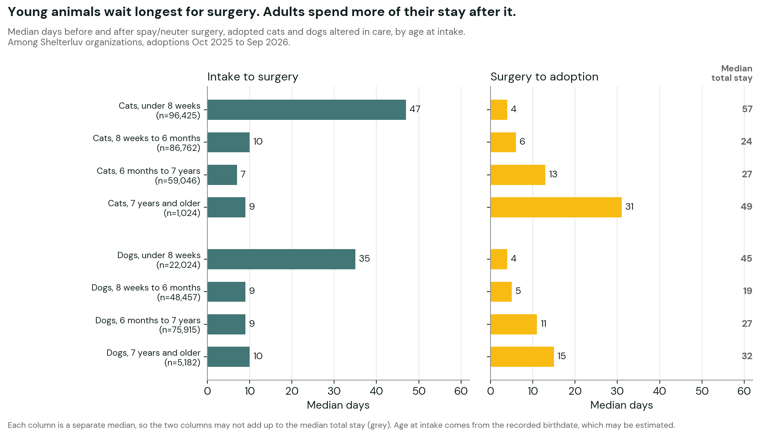 Cats and dogs adopted from October 2025 through September 2026 who had spay/neuter surgery during their stay. Each figure is a separate median; the before-and-after medians don’t necessarily add up to the median total stay.
That distinction matters when comparing organizations. A shelter caring for several litters of young kittens will naturally have different timelines than one primarily serving adult animals.
Before asking why animals are waiting, start by comparing animals with similar needs.
Nearly half the days came after surgery
Across all ages, animals in this analysis spent 11.1 million days in care before surgery and 10.5 million afterward.
For adults between six months and seven years old, the difference was even greater: 2.4 million days before surgery and 5.2 million after.
Roughly two-thirds of their combined time in care came after surgery.
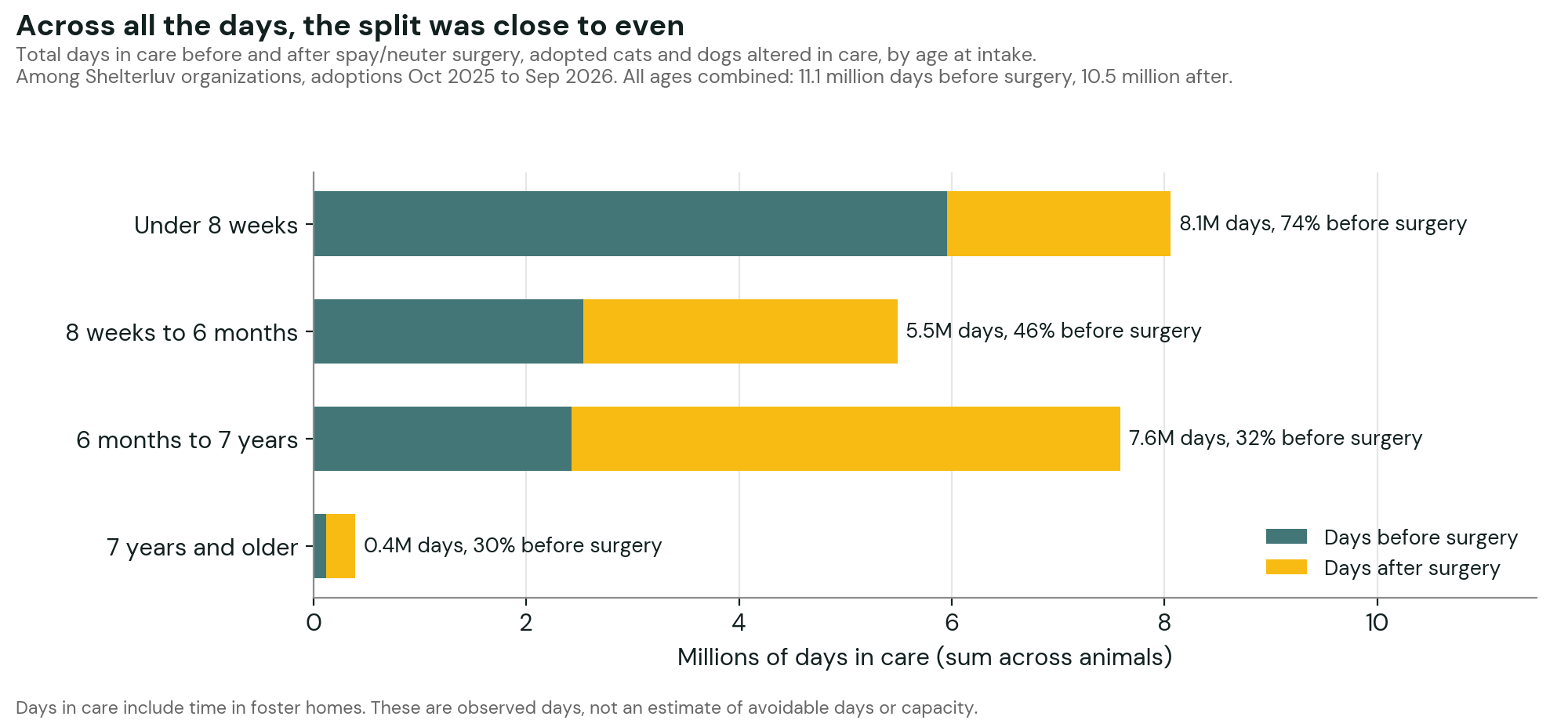 Total days across the stays of cats and dogs adopted from October 2025 through September 2026 who had surgery during that stay. Both periods include foster care. These figures do not measure kennel occupancy or cost.
Those totals represent a lot of work. Animals recovering in foster homes, staff coordinating appointments, volunteers providing care, and adoption teams connecting pets with people.
We also examined organizations individually. Among those with at least 20 eligible adoptions, 55% had a median wait of two weeks or more between surgery and adoption.
That's not a performance target or evidence of wasted time. It does suggest that conversations about length of stay shouldn't stop with the medical team.
The foster and adoption teams have an important part of this story, too.
What happens during kitten season?
The time after surgery also changed throughout the year.
Adult cats adopted in February spent a median of nine days between surgery and adoption. For those adopted in July, it was eighteen.
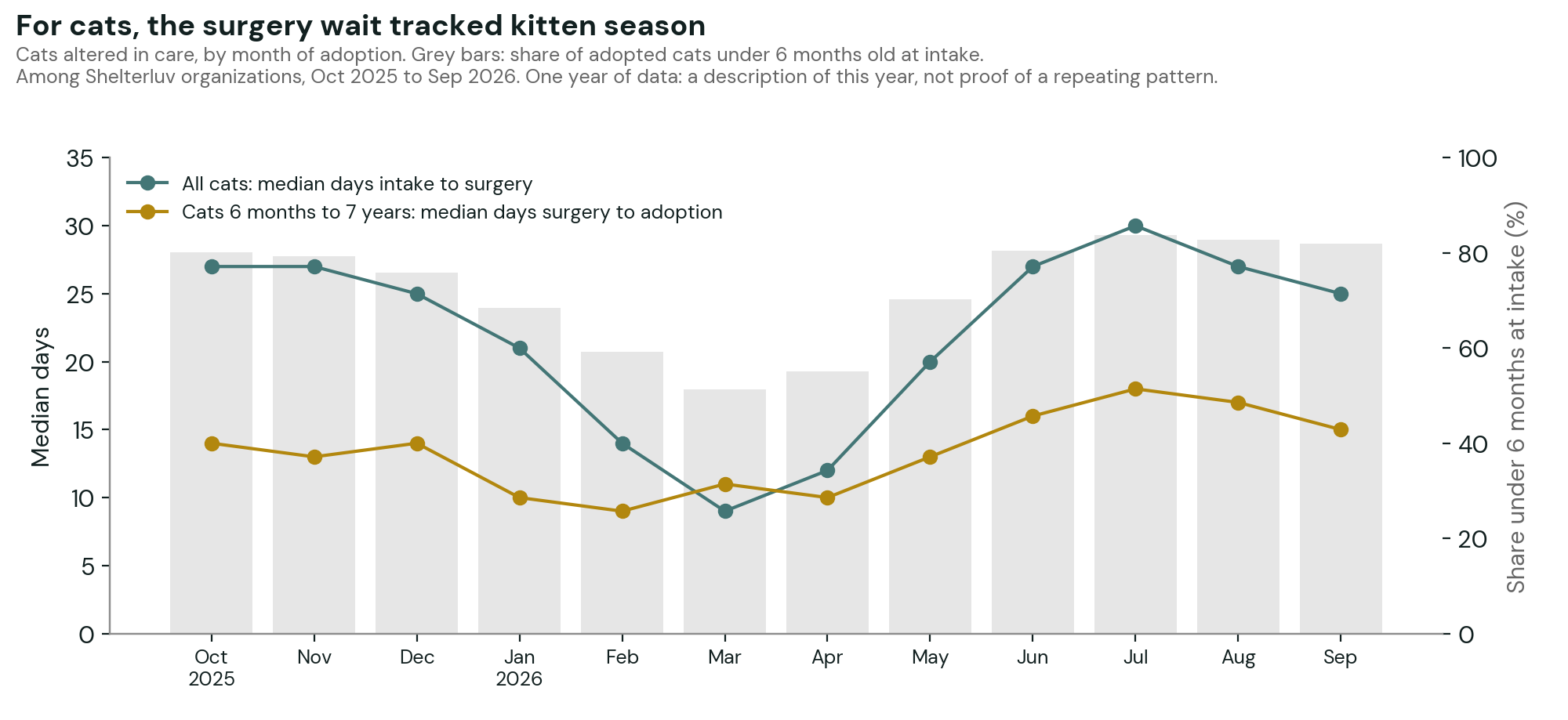
Cats spayed or neutered during their stay, by month of adoption. Lines show median days from intake to surgery (all cats) and from surgery to adoption (cats 6 months to 7 years). Grey bars show the share of adopted cats who were under 6 months old at intake. Among Shelterluv organizations, October 2025 through September 2026.
That doesn't prove kitten season caused the increase. We're looking at one year of adoptions, and the dates don't tell us why individual animals stayed longer.
But it's worth comparing with your own experience.
When kittens fill available spaces and demand more attention, what happens to adult cats? Are their profiles current? Are interested adopters receiving follow-up? Does anything get harder to manage when the team is stretched?
Your records might reveal a similar pattern, or something entirely different.
Animals arriving already altered spent less time in care
Among adult cats, those arriving already spayed or neutered had a median stay of 18 days. Cats altered during their stay had a median of 27 days.
For adult dogs, it was 20 days compared with 27.
The pattern held across individual organizations, too. Stays were longer for animals altered in care at 83% of organizations in the adult-cat comparison and 75% in the adult-dog comparison.
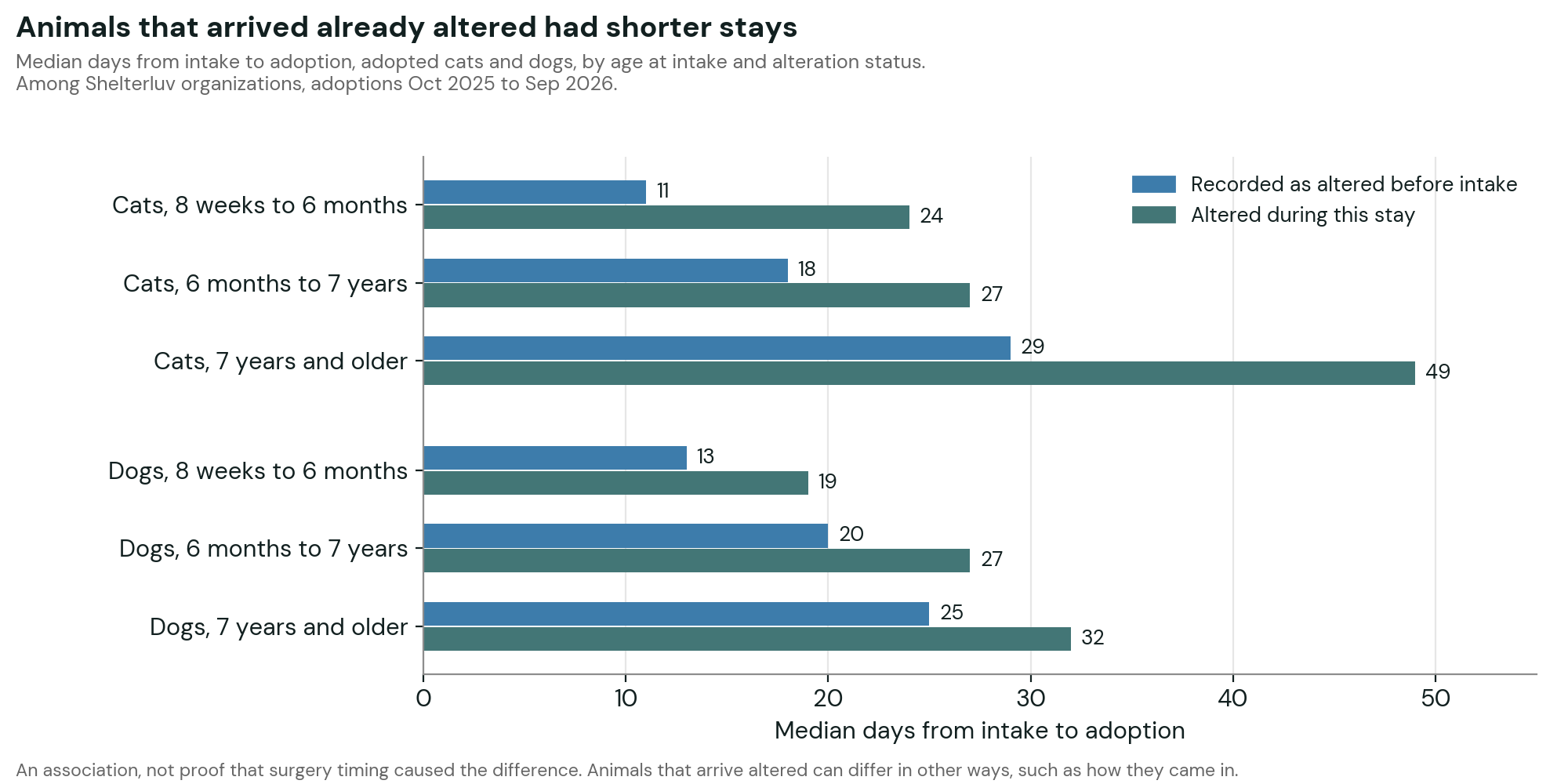 Days from intake to adoption, grouped by species and age at intake, for adoptions from October 2025 through September 2026. The differences show an association, not the effect of surgery alone.
It's tempting to look at those gaps and conclude that earlier surgery would save seven to nine days. The data doesn't support that conclusion. Animals arriving already altered might differ in health, intake source, or other needs.
Still, the comparison gives organizations a reason to examine the process.
How quickly do medically eligible animals get scheduled? When surgery is complete, how does the adoption team know what's next?
Sometimes the process works exactly as intended. Other times, a task sits unfinished because everyone assumes someone else owns it.
Find the days you can change
You don't need millions of records to investigate your own timeline.
Start with animals adopted during the past 90 days who had surgery during their stay. Use a longer period if your adoption volume is smaller. Separate cats from dogs, group them by age, and compare median days before and after surgery.
Then select 10 to 20 animals with longer waits after surgery. Bring those records to the people who cared for them.
Ask when each animal was medically ready for adoption, when their profile became available, and whether anything delayed the next step.
Surgery completed and ready for adoption aren't always the same milestone. That's a distinction worth tracking.
Choose a change that fits what you find
Suppose several animals were ready for adoption but didn’t have complete profiles. There’s a specific task to address: decide who owns that work, when it should happen, and who fills in when that person is unavailable.
Other findings will call for other changes.
| What you find | Something to try | What to track |
|---|---|---|
| Photos or profiles are incomplete when animals become ready | Assign responsibility and a completion date | Days from readiness to a complete, published profile |
| Foster meet-and-greets repeatedly stall | Agree on a scheduling handoff and backup contact | Time from inquiry to an offered appointment |
| Medically eligible animals remain unscheduled | Review animals awaiting surgery appointments regularly | Days from documented eligibility to surgery |
| Treatment or holds continue without a reassessment date | Record the next review date and responsible person | Whether reassessments happen as planned |
These are examples to consider, not explanations established by the study.
Choose one change and set a date to check back. A month may work for an initial review; smaller organizations may need longer. Ask whether it helped animals move forward and what it required from the team. A change that only shifts the unfinished work to someone else probably needs another look.
Keep a separate list for animals still in care. Their stays are unfinished, so they can’t be compared directly with completed adoptions. For them, record what they’re waiting for, who has the next action, and when someone will follow up.
If nobody is sure what the next step is, you’ve already found something to address.
What the dates don't tell us
Intake, surgery, and adoption dates reveal where time accumulates, but not why.
They don't distinguish necessary medical treatment from scheduling delays or explain what happened during foster care. The analysis also includes completed adoptions only, excluding animals still in care and those with other outcomes.
Documentation matters, too. Missing or late surgery records affect the timelines.
That's why the people behind the records are as important as the numbers. A longer stay might reflect excellent care for an animal with complex needs. Another might reveal a missed handoff that nobody noticed.
The goal isn't to make every stay shorter. It's to understand why an animal is still waiting and whether the next step is clear.
Questions for Monday
- Which animals spend the most time waiting before surgery, and which spend the most time afterward?
- When an animal is still in care after surgery, do we know what they're waiting for?
- What's one recurring delay we could investigate this month?
Bring a few records to your next team meeting. Listen to the people who know those animals, identify one opportunity, and agree on when you'll review the results.
Sometimes the most useful finding isn't how many days an animal spent in care. It's discovering which of those days you have the power to change.
📅 Next month, we look at foster
A foster coordinator juggling placements and a volunteer turning a spare bathroom into a kitten nursery know how much work goes into foster care.
But what do the records tell us about its impact on time to adoption?
Fostered animals sometimes have longer stays because they enter foster care precisely when they're too young for adoption or still need medical attention.
Next month, we'll compare kittens with kittens and adults with adults to see how the picture changes. The goal is a fairer way to understand foster timelines, one that reflects the animals' needs and the work of the people caring for them.
About this analysis
-
Time period and organizations. The analysis covers October 2025 through September 2026, including Shelterluv organizations with adoptions in at least ten of those twelve months and accounts opened at least one year before the study period. Results aren't national averages or performance benchmarks.
-
Animals included. Before-and-after comparisons include adopted cats and dogs with recorded spay/neuter surgery during their stay. A separate comparison examines animals already altered at intake. Age groups use age at intake.
-
Calculations. Medians were calculated separately for each interval. Organization-level comparisons include organizations with at least 20 eligible adoptions. Total days include foster care, not just kennel occupancy.
-
Data limitations. Approximately one in five surgery records was entered more than a day after its stated date. Restricting the analysis to promptly entered or advance-scheduled records lowered overall medians from 17 to 15 days before surgery and seven to five afterward, without changing the broad pattern. Surgery performed elsewhere appears only when documented in Shelterluv.